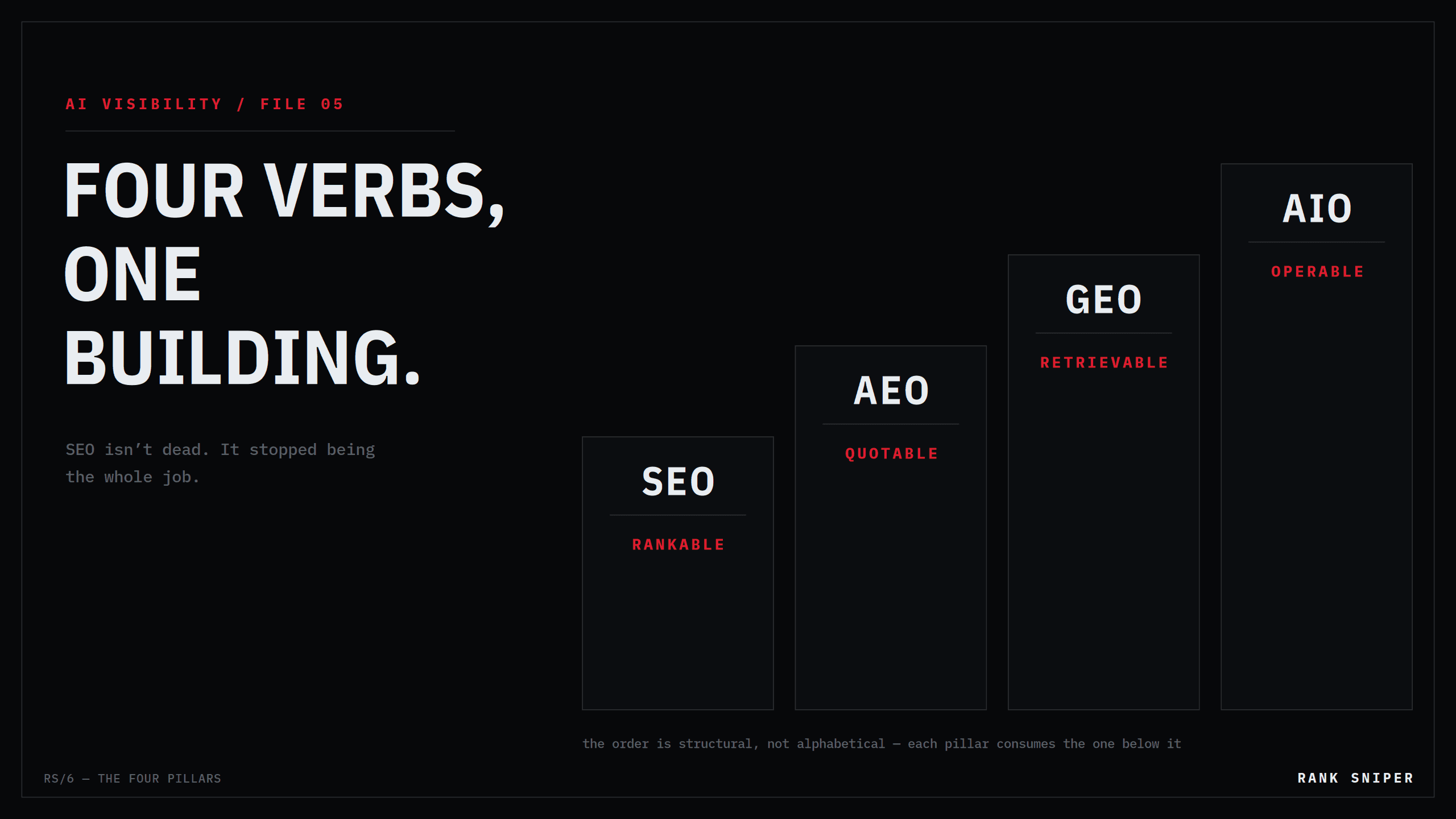
Tomás got three agency pitches in the same week. The first told him SEO was dead and he needed to "pivot everything to GEO." The second said GEO was hype and the real opportunity was AEO, which was apparently different. The third quoted him a retainer for "AI SEO," which, pressed for a definition, turned out to mean blog posts.
He forwarded all three to a friend with one line: "Are any of these real?"
Fair question, and here's the honest answer: the acronyms are real, the confusion is manufactured, and most of the people selling the letters can't define them. This article gives you the working taxonomy we hold ourselves to — four pillars, one verb each, in an order that isn't alphabetical or chronological but structural. By the end you'll be able to place any pitch, tool, or tactic into exactly one box, and — using the earlier files in this series — place your own store against all four.
Why the soup exists
For two decades, "being found by machines" meant one machine audience: search engine crawlers ranking pages. One audience, one discipline, one acronym.
That audience has split four ways. Ranked search still exists and still converts. Answer engines extract and cite facts instead of listing links. Generative engines compose recommendations from retrieved sources. And agents — the newest audience — don't just describe products, they act on them: compare, select, increasingly transact.
Each audience reads your catalog differently, fails on different gaps, and rewards different work. That's why the acronyms multiplied — the underlying machines genuinely diverged. The dysfunction isn't the letters; it's that they're sold as competing religions when they're four floors of one building.
The four pillars
Here they are, in the order we always present them — and always will, because the order carries the argument.
SEO — Search Engine Optimization
Making your catalog rankable: eligible to appear, and positioned to be chosen, in ranked search results.
The audience: crawlers and ranking systems building ordered result lists. What good looks like: indexable pages, sound canonical structure, real titles, crawlable architecture, content that earns its position. What fails: the classics — blocked crawlers, duplicate hosts, thin pages, broken hreflang. SEO is the floor of the stack, and it's still the floor — nothing above works on a site search engines can't cleanly index. Anyone opening with "SEO is dead" is selling the upper floors of a building with no foundation.
AEO — Answer Engine Optimization
Making your catalog quotable: structured so answer engines can extract, attribute, and cite your facts directly.
The audience: systems that answer questions with attributed facts rather than ranked links. What good looks like: facts stated extractably — one clean claim per surface — with structured data that lets the engine attribute price, availability, and specifics to you with confidence. What fails: facts trapped in marketing prose, markup that never ships in the response, pages where the answer to a buyer's question exists visually but not structurally. The test is brutal and simple: can an engine lift a fact from your page and put your name under it without inferring anything?
GEO — Generative Engine Optimization
Making your catalog retrievable: legible to generative systems so your products are drawn into composed recommendations.
The audience: generative engines assembling recommendations from a retrieved candidate set. What good looks like: being in the candidate set — parseable, coherent, corroborated across sources, described in terms machines can match to a buyer's constraints. What fails: absence, which produces zero signal — the ladder-versus-door problem. GEO is where "ranked low" stops existing as a state; you're material for the composition or you're not consulted.
AIO — AI/agent readiness
Making your catalog operable: complete and trustworthy enough for an AI agent to act on — compare, select, and transact.
The audience: agents that do things, not just say things. What good looks like: records complete in the key columns — identity, availability, price, per variant — plus the emerging feed and protocol surfaces that let an agent move from recommendation to transaction. What fails: everything the legibility teardown covered: records an agent would have to guess about, and agents don't guess. AIO is the ceiling of the stack and the youngest discipline — which is exactly why it's where early, correct work compounds hardest.
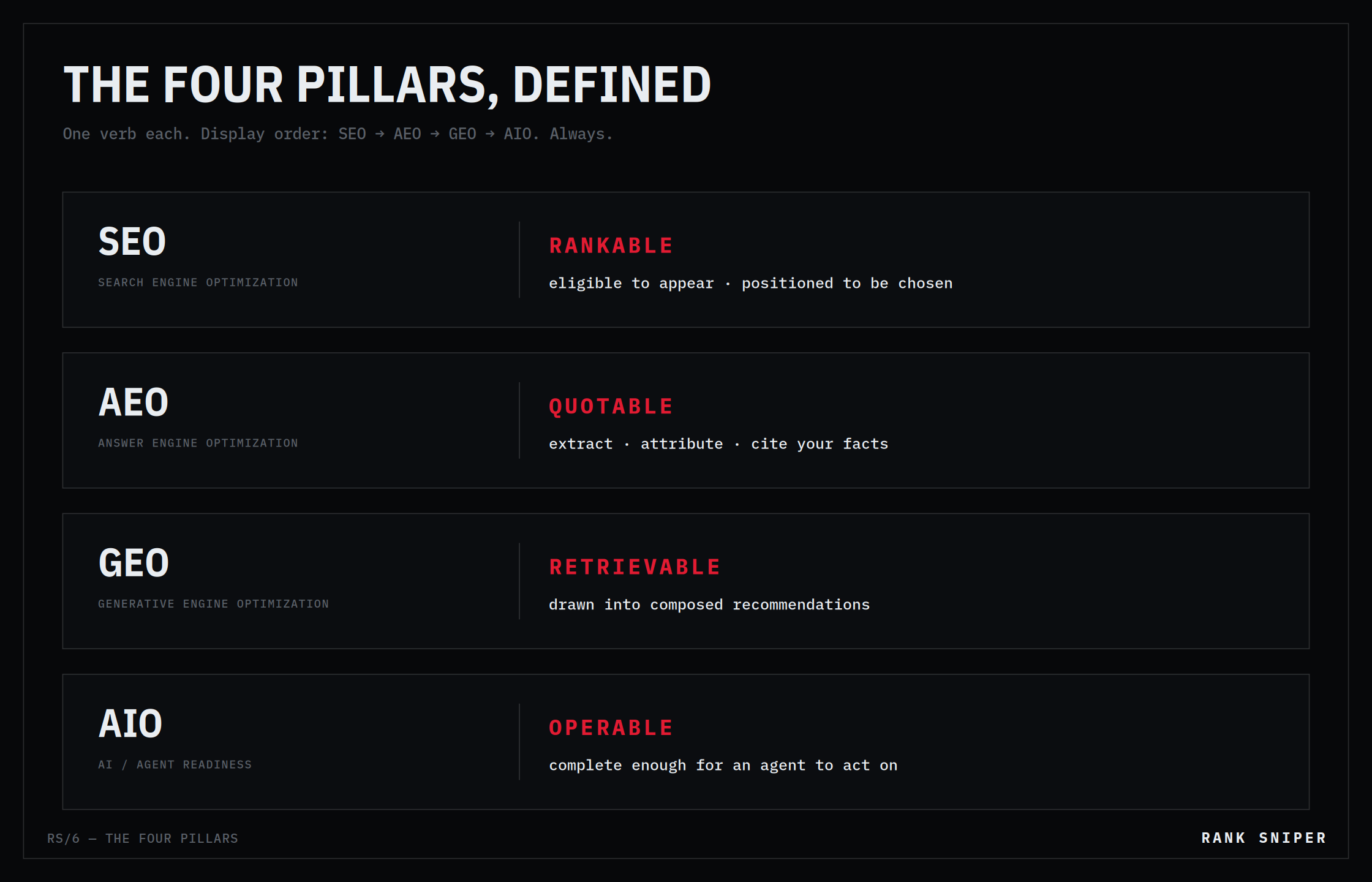 FIG.02 — The four pillars, defined. One verb each, in the display order we always use: SEO → AEO → GEO → AIO.
Why the order matters
SEO → AEO → GEO → AIO isn't a menu. It's a dependency chain, and it runs in one direction.
A page that can't be crawled and indexed (SEO) has nothing to extract (AEO). A fact that can't be extracted and attributed can't corroborate you into a candidate set (GEO). A product that can't be retrieved into recommendations will never be transacted on by an agent (AIO). Each pillar consumes the one below it. Skip a floor and the floors above stand on air.
This is also why the three infrastructure layers from earlier in this series — access, delivery, legibility — aren't a fifth pillar: they're the plumbing that runs through all four. An open robots.txt serves every pillar at once. A hardcoded InStock damages every pillar at once. Fix the plumbing and all four floors improve; that's what makes it the highest-leverage work in the building.
And it's why the "SEO is dead" pitch and the "GEO is hype" pitch are both wrong in the same way: each treats one floor as the building.
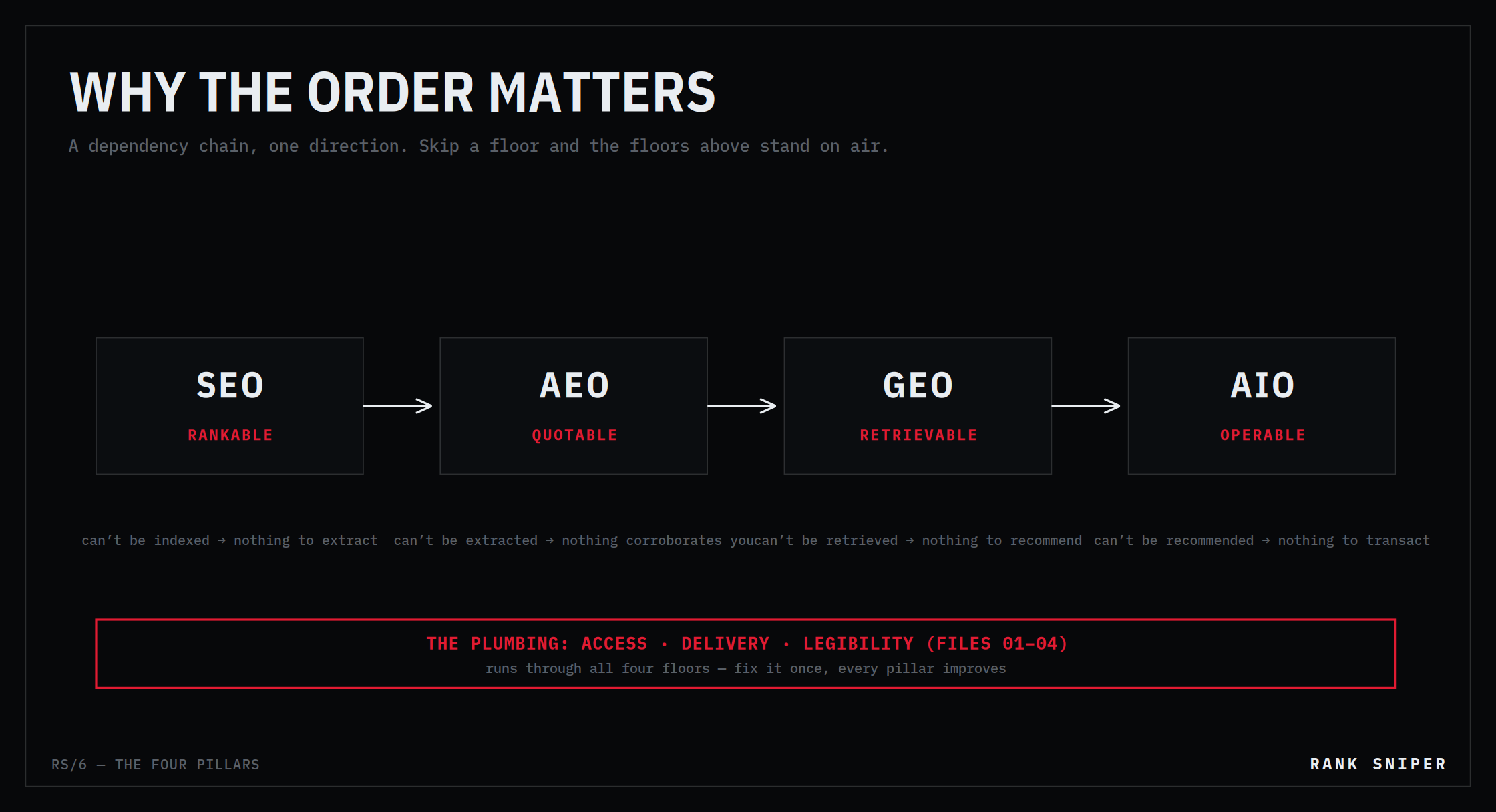 FIG.03 — A dependency chain, one direction. Each pillar consumes the one below it, and the plumbing runs through all four floors at once.
One catalog, four judges
The practical consequence: the same product page is being judged four different ways, simultaneously, by machines asking different questions.
The ranking system asks: does this page deserve position? The answer engine asks: can I quote this and sign it? The generative engine asks: is this usable material for a recommendation? The agent asks: can I act on this without guessing?
Most wasted effort in this space is answering a different judge than the one that failed you. Writing more blog content (an SEO/AEO tactic) doesn't fix a catalog agents can't operate (an AIO failure). Adding schema (an AEO tactic) that ships client-side fixes nothing anywhere. Diagnosis before tactics — which judge, which floor, which layer.
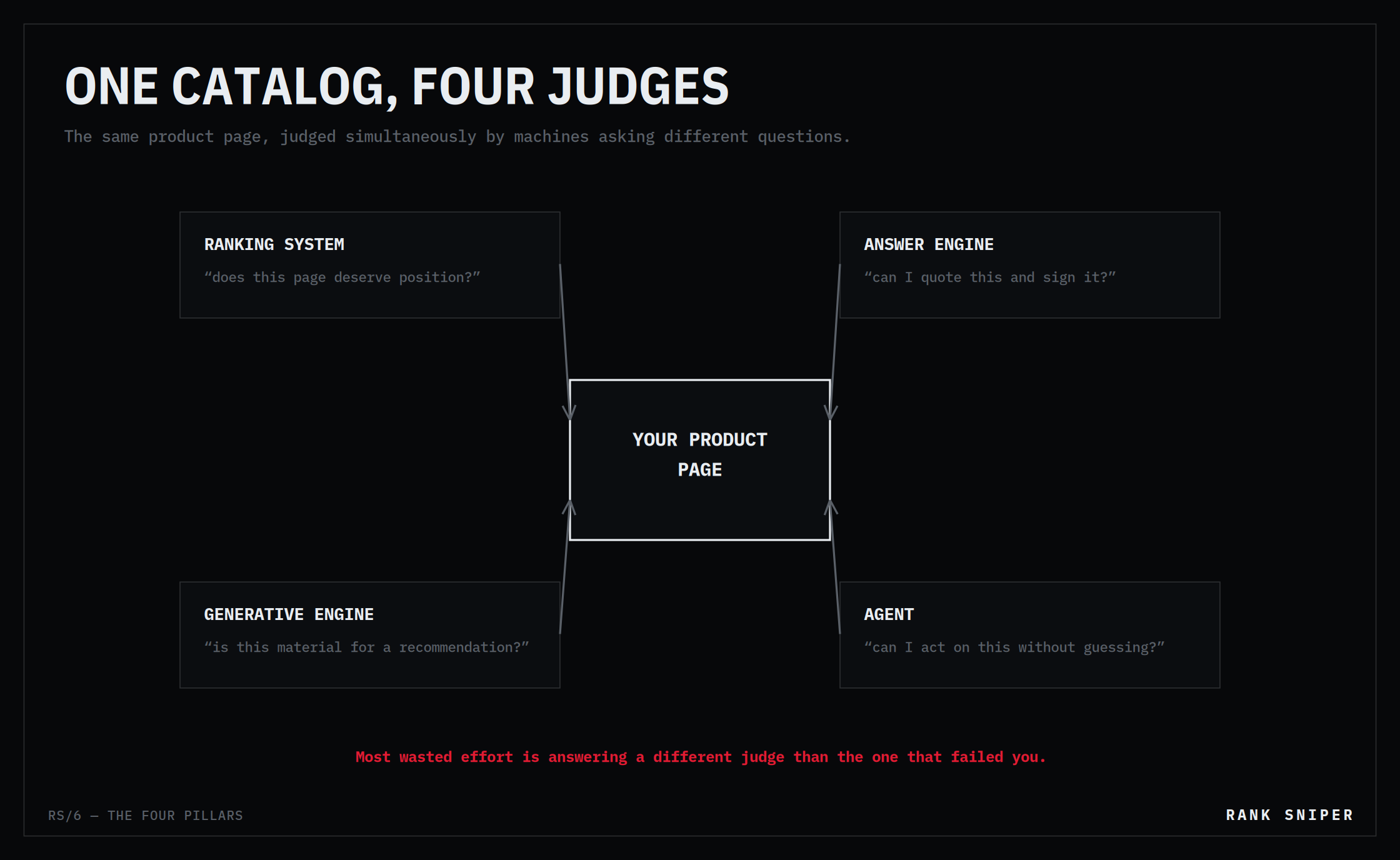 FIG.04 — Four judges, four questions, one page. Most wasted effort answers a different judge than the one that actually failed you.
Where your store stands: one check per pillar
Fifteen minutes, one question per pillar, using tools from the earlier files.
SEO / RANKABLE. In Google Search Console, check your product pages: indexed, canonical on the right host, no duplicate-host bleed? (If your GSC is a graveyard of www duplicates and locale confusion, that's floor-one work, before anything else.)
AEO / QUOTABLE. Pick your best seller. Ask an answer engine a fact question about it — "what does [product] cost at [store], and is it in stock?" Right answer with your name attached: quotable. Wrong, hedged, or sourced to a marketplace instead of you: extraction is failing somewhere between your admin and the wire.
GEO / RETRIEVABLE. The category question test from FILE 03: three customer questions in your niche, asked in two engines. Cited, or absent?
AIO / OPERABLE. The three greps from FILE 04: identifiers shipping, availability true, offers per variant. Three commands, three verdicts.
Four checks, four verdicts, and now Tomás's question answers itself: every pitch either names the floor it works on and how it'll prove the work — or it's selling letters.
Name it, then measure it
A taxonomy earns its keep when it stops being vocabulary and starts being measurement: four pillars a store can be scored against, layer by layer, with every claim checkable at the wire. That's the discipline this whole series has been building toward, one floor at a time, and it's the standard we build our own verification work around — the four pillars above aren't marketing language for us, they're the axes of the audit. How scoring should actually work — what deserves a number, what a single vanity score hides, and why "eligible" and "implemented" are different facts — is where the series goes next.
For today: four verbs on an index card. Rankable. Quotable. Retrievable. Operable. Every machine-visibility decision you'll make this year is one of those four words wearing a costume.
Sources & further reading
- Google — SEO Starter Guide (the floor, still load-bearing): https://developers.google.com/search/docs/fundamentals/seo-starter-guide
- Google — AI features and your website: https://developers.google.com/search/docs/appearance/ai-features
- OpenAI — ChatGPT search documentation: https://help.openai.com/en/articles/9237897-chatgpt-search
- schema.org — Product and Offer vocabulary underlying extraction: https://schema.org/Product
- Rank Sniper Field Notes — FILE 01 robots.txt: /blog/robots-txt-ai-crawlers-shopify · FILE 02 declared vs delivered: /blog/ai-agent-declared-vs-delivered-product-page · FILE 03 the invisible channel: /blog/shopify-store-invisible-ai-buyers · FILE 04 the legibility layer: /blog/product-attributes-ai-systems-refuse-to-guess
Rank Sniper — Field Notes. Catalog legibility and AI-visibility verification for Shopify. We verify what AI agents actually receive from your store; we don't generate content and hope. Verifier, not generator.