Priya has run a candle store on Shopify for six years. Last month, doing her quarterly numbers, she noticed something odd in her analytics: a thin trickle of sessions referred from chatgpt.com and perplexity.ai. Maybe forty visits. She almost scrolled past — except those forty visits had converted at nearly triple her store average.
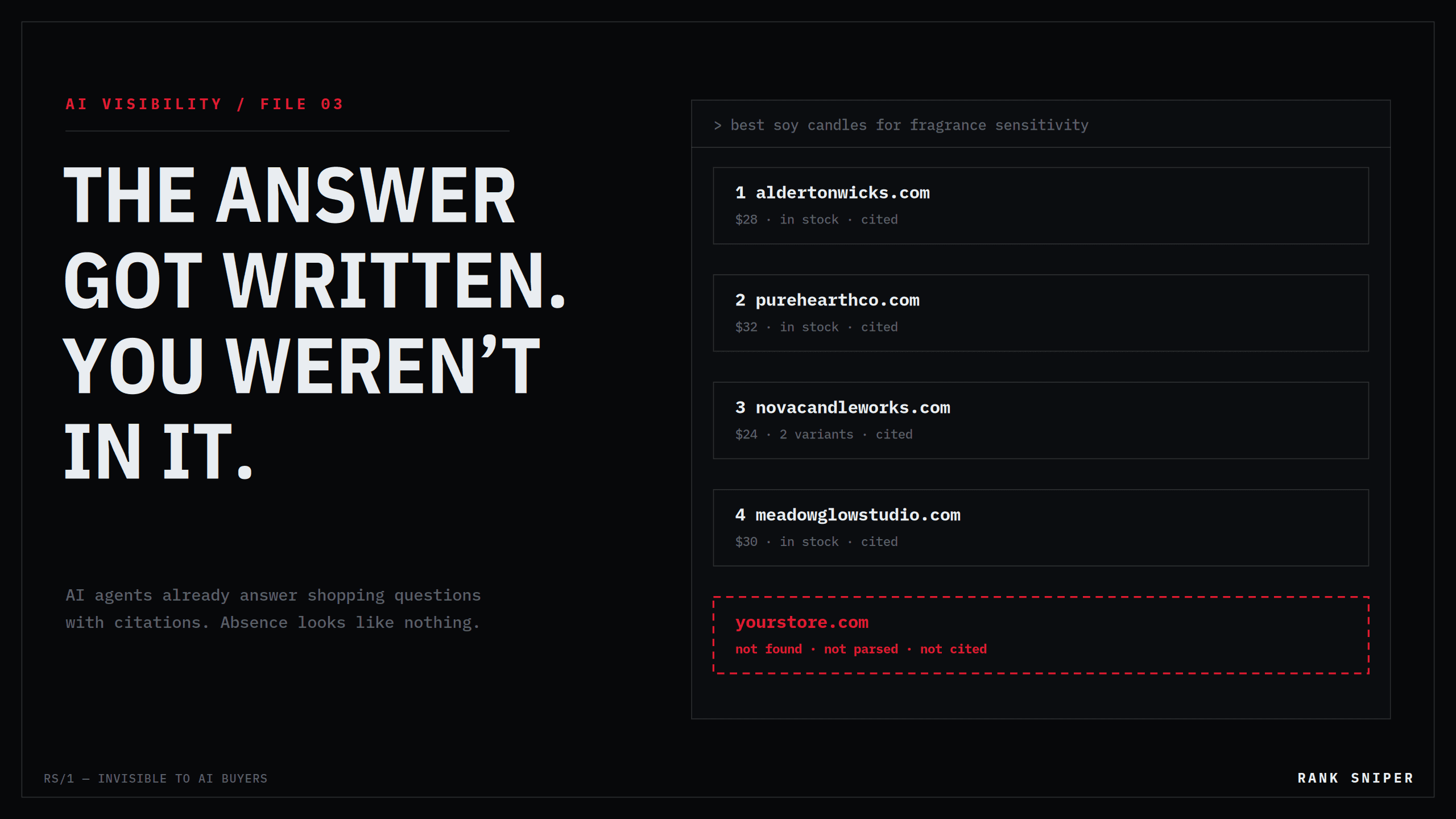
Curious, she opened ChatGPT and asked the question her own customers would ask: "What are the best soy candles for people sensitive to fragrance?" — her exact niche, the one she's spent six years owning.
The answer named four stores. Cited them. Linked them. Quoted prices from two.
She wasn't fourth. She wasn't tenth. She wasn't anywhere.
That combination — converts brilliantly when it arrives, arrives almost never — is what this new channel looks like from inside a merchant dashboard. And it's why most store owners are misreading it: the trickle looks too small to matter, so nobody asks why it isn't a stream.
The channel your dashboard can't count
Start with why the numbers look so small, because it changes what they mean.
When an AI assistant answers a shopping question, most of the transaction between your catalog and the buyer happens before any click exists. The agent reads product data, compares options, states prices, summarizes availability — and the buyer often acts on the answer without visiting anyone. If they do click through, referral data frequently arrives stripped or misattributed, landing in "direct" traffic where it's indistinguishable from someone typing your URL.
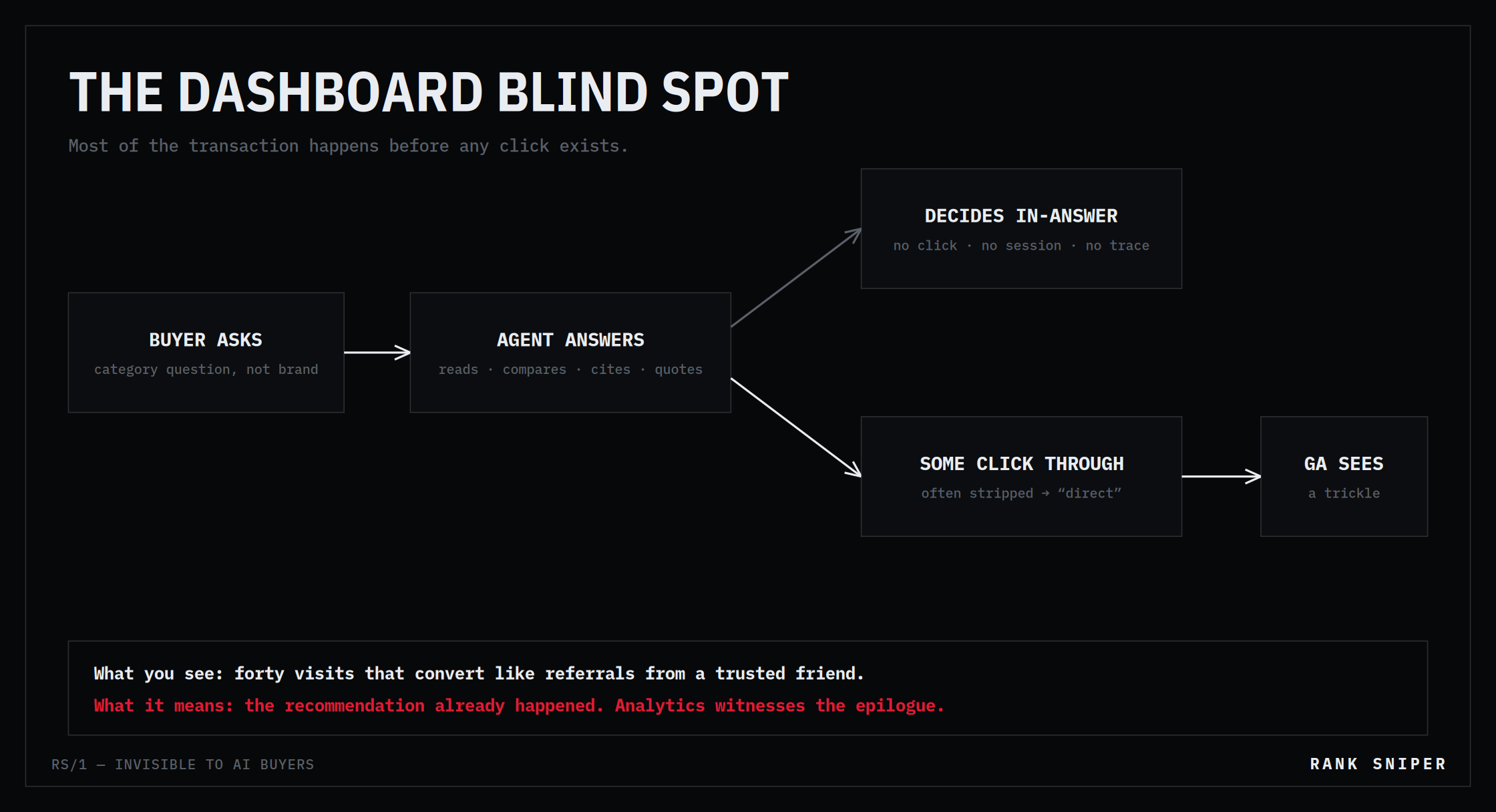 FIG.02 — Where the channel disappears. Analytics can only witness the readers who clicked; the decision already happened inside the answer.
So the sessions you can see from AI sources are a shadow of the influence. Every one of Priya's forty visits was a person who read an answer, made most of their decision inside it, and still cared enough to click. That's why they convert like referrals from a trusted friend — because functionally, that's what they are. The recommendation already happened. Your analytics only witnesses the epilogue.
Which reframes the real question. Not "how much traffic is AI sending me?" — that number will always under-report. The question is: when the answer gets written, is your store in it?
Invisible is not the same as ranked low
Merchants carry twenty years of SEO intuition into this channel, and the core intuition — visibility is a ladder, and effort moves you up rungs — is exactly wrong here.
Search rankings are a spectrum. Position eight is worse than position one, but it exists. It gets some clicks, some impressions; you can see yourself on the board and grind upward.
AI answers are closer to binary. The engine retrieves a set of candidate sources it can parse and trust, composes an answer from them, and cites what it used. Either your catalog was in the candidate set — parseable, coherent, priced, available, identified — or it wasn't consulted at all. There is no position eight inside a paragraph. There's the answer, and there's absence, and absence produces zero signal in any dashboard you own. You don't see a low ranking. You see nothing, which looks identical to the channel not mattering.
That's the trap Priya nearly fell into, and it compounds: the merchants with the least AI visibility see the least evidence that AI visibility exists.
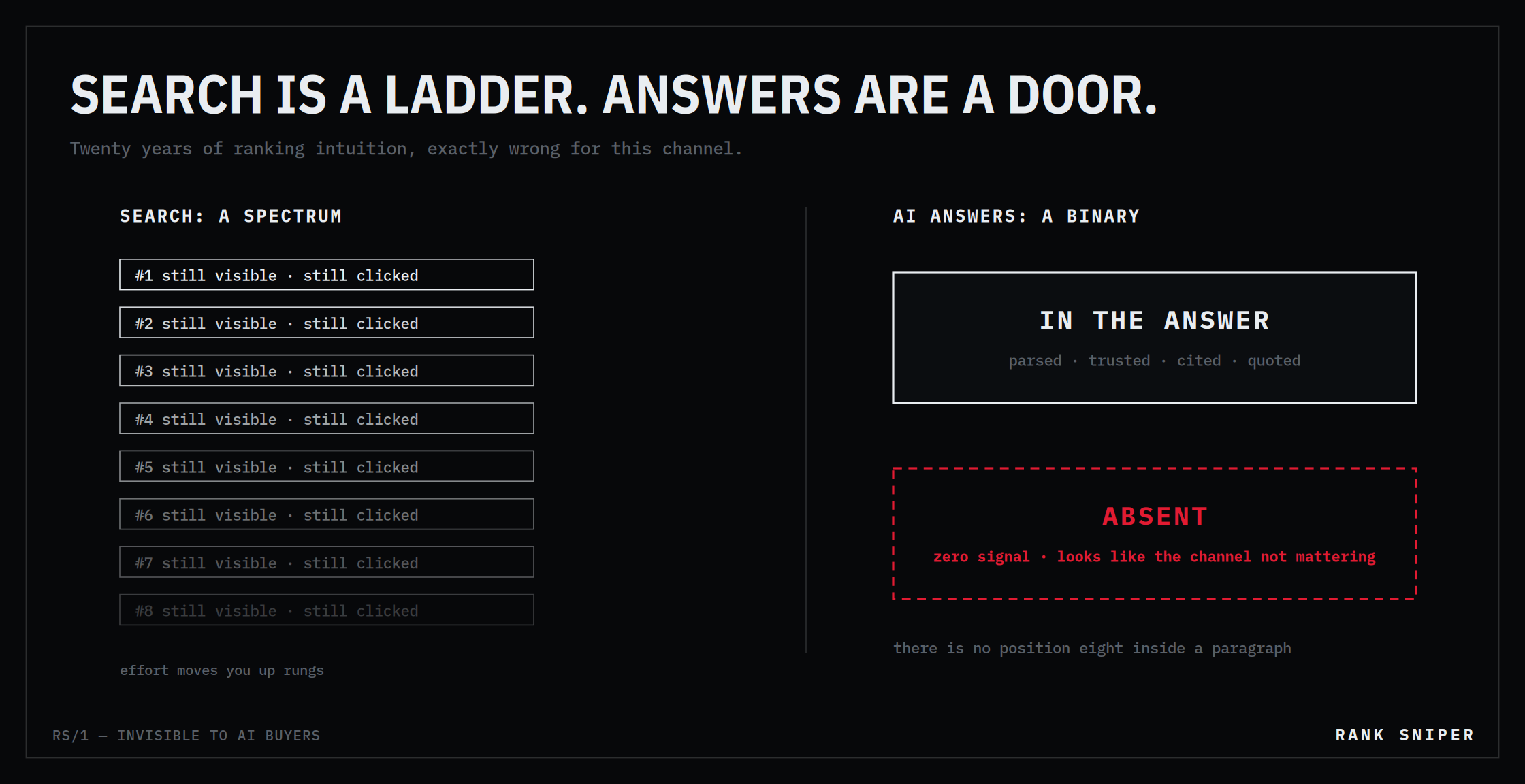 FIG.03 — A ladder has a rung eight. An answer does not. Absence produces zero signal, which reads exactly like a channel that does not matter.
Why good stores are the ones missing
Here's the uncomfortable part: invisibility has almost nothing to do with store quality as humans judge it. Priya's products are excellent. Her photography is beautiful. Her reviews are real. None of that is legible to a machine assembling an answer, because machine legibility fails at three specific layers — each invisible from a browser, each auditable in minutes.
Layer one: access. Can AI crawlers reach your store at all? A remarkable number of Shopify stores block them without knowing — through a 2023-era robots.txt snippet, an SEO app's default toggle, or a firewall that overrides what robots.txt promises. We mapped every crawler that matters and the three silent blocking patterns in our robots.txt field guide, including a self-audit that takes about fifteen minutes.
Layer two: delivery. When a crawler does get in, does your product data exist in the response it receives? AI crawlers read raw HTML and don't execute JavaScript — so schema injected by apps, prices rewritten by scripts, availability rendered by widgets, and review stars painted client-side simply aren't there for the machine. Your page can pass Google's tests and still be unreadable to the agents writing answers. That gap — declared spec versus delivered reality — gets its own teardown here.
Layer three: legibility. Even delivered data can be too thin to use. A product with no stable identifier, ambiguous variants, or an availability field that's hardcoded rather than true gives the engine a choice between guessing and skipping — and engines that answer with citations don't guess. They skip. Silently. (This layer is where the series goes next.)
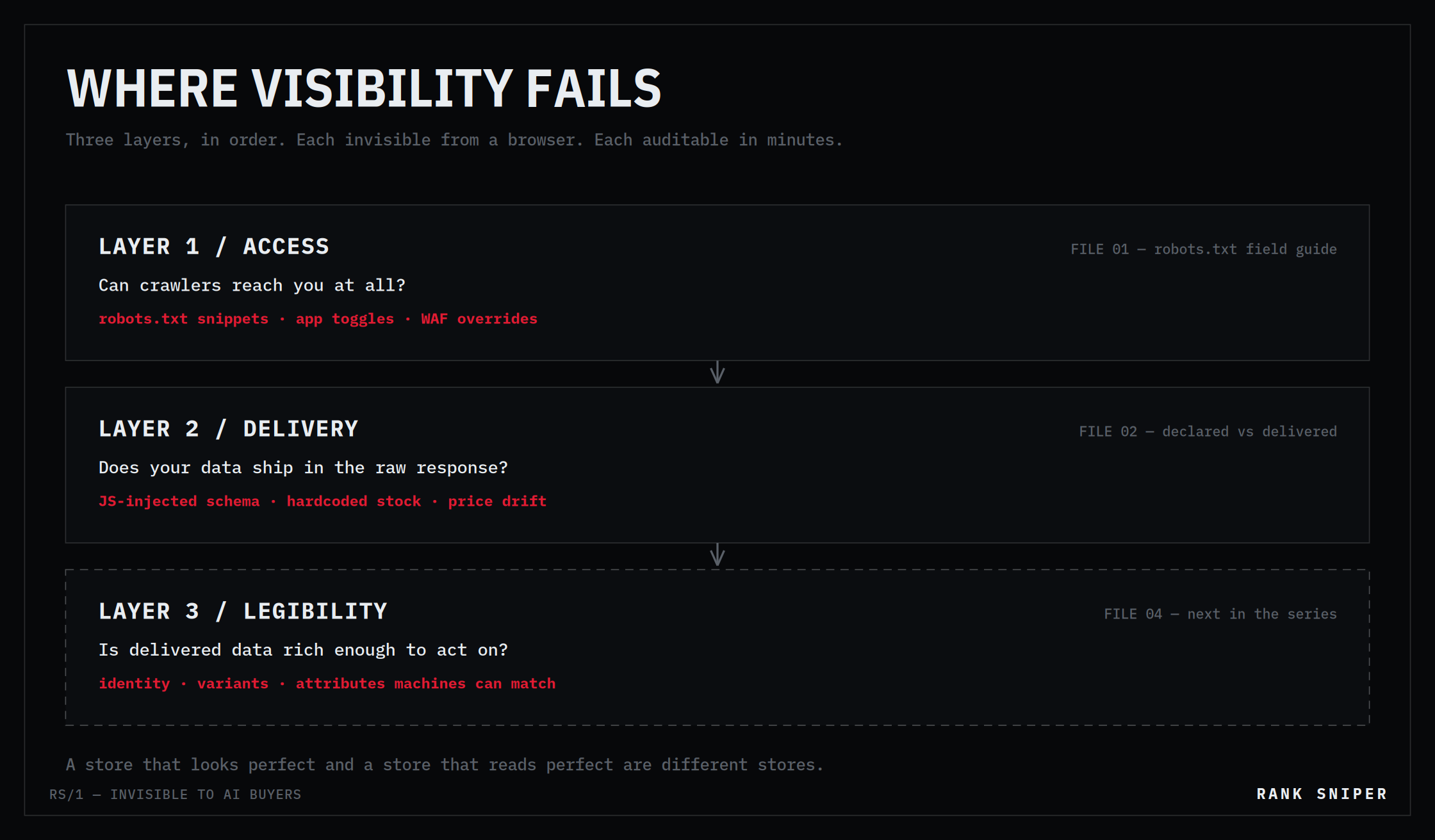 FIG.04 — Three layers, in order. Each one is invisible from a browser, and each one is auditable in minutes.
Notice what these three layers have in common: not one of them shows up when you look at your own store the way a customer does. The store that looks perfect and the store that reads perfect are different stores, and only one of them gets quoted.
The fifteen-minute reality check
You don't need tooling to find out where you stand today. You need three checks and honesty about the results.
CHECK 01 / ASK THE ENGINES YOUR OWN QUESTION. Write down the three questions a customer would ask in your category — not your brand name, your category. ("Best soy candles for fragrance sensitivity." "Durable travel backpack under $200 with laptop sleeve.") Ask them in ChatGPT and Perplexity. Record who gets named and cited. If you appear: note what they say about you and whether it's accurate. If you don't: you now know something your dashboard would never have told you.
CHECK 02 / READ YOUR ROBOTS.TXT. Open yourstore.com/robots.txt and look for blocks against GPTBot, ClaudeBot, PerplexityBot, OAI-SearchBot, or anything commented "AI." Full walkthrough, including the firewall case that blocks despite an open file, in the field guide.
CHECK 03 / VERIFY THE WIRE. One command tells you whether your product schema actually ships to crawlers or only exists in your browser:
curl -s https://yourstore.com/products/your-best-seller \
| grep -c 'application/ld+json'
Zero, while your apps show green checkmarks, means your structured data is declared but never delivered — the most common gap class we see, and invisible from any dashboard.
Fifteen minutes. Three answers. Most merchants who run this come back with at least one uncomfortable result — and an uncomfortable result you can see beats an invisible one you can't.
The channel is being written now
Here's the strategic point underneath the tactics. AI answers have a property search never had: persistence through synthesis. When engines repeatedly find, parse, and cite the same set of stores for a category, those stores become the default material the category's answers are built from. Early legibility compounds. Absence compounds too.
That's not a reason to panic. It's a reason to treat this like the infrastructure problem it is, rather than the marketing problem it resembles. Access, delivery, legibility — each layer is checkable, fixable, and verifiable, in that order. The checks above are the manual version. Doing it systematically — every product, every layer, verified against what machines actually receive rather than what your apps claim — is the discipline we build tooling around, and the standard we think every store should hold any tool to: prove it at the wire, or it isn't fixed.
Priya's category question now returns five stores. Getting there wasn't content, ads, or a redesign. It was making six years of genuinely good work readable by the machines her customers now ask first.
Your store may already be better than every competitor an AI names. The machines just can't tell yet.
Sources & further reading
- OpenAI — ChatGPT search & shopping results documentation: https://help.openai.com/en/articles/9237897-chatgpt-search
- Perplexity — Shopping and answer citations: https://www.perplexity.ai/hub
- Google — AI Overviews and how they cite sources: https://developers.google.com/search/docs/appearance/ai-features
- Rank Sniper Field Notes — I Read Your robots.txt So You Don't Have To (layer one): /blog/robots-txt-ai-crawlers-shopify
- Rank Sniper Field Notes — What an AI Agent Actually Sees (layer two): /blog/ai-agent-declared-vs-delivered-product-page
Rank Sniper — Field Notes. Catalog legibility and AI-visibility verification for Shopify. We verify what AI agents actually receive from your store; we don't generate content and hope. Verifier, not generator.