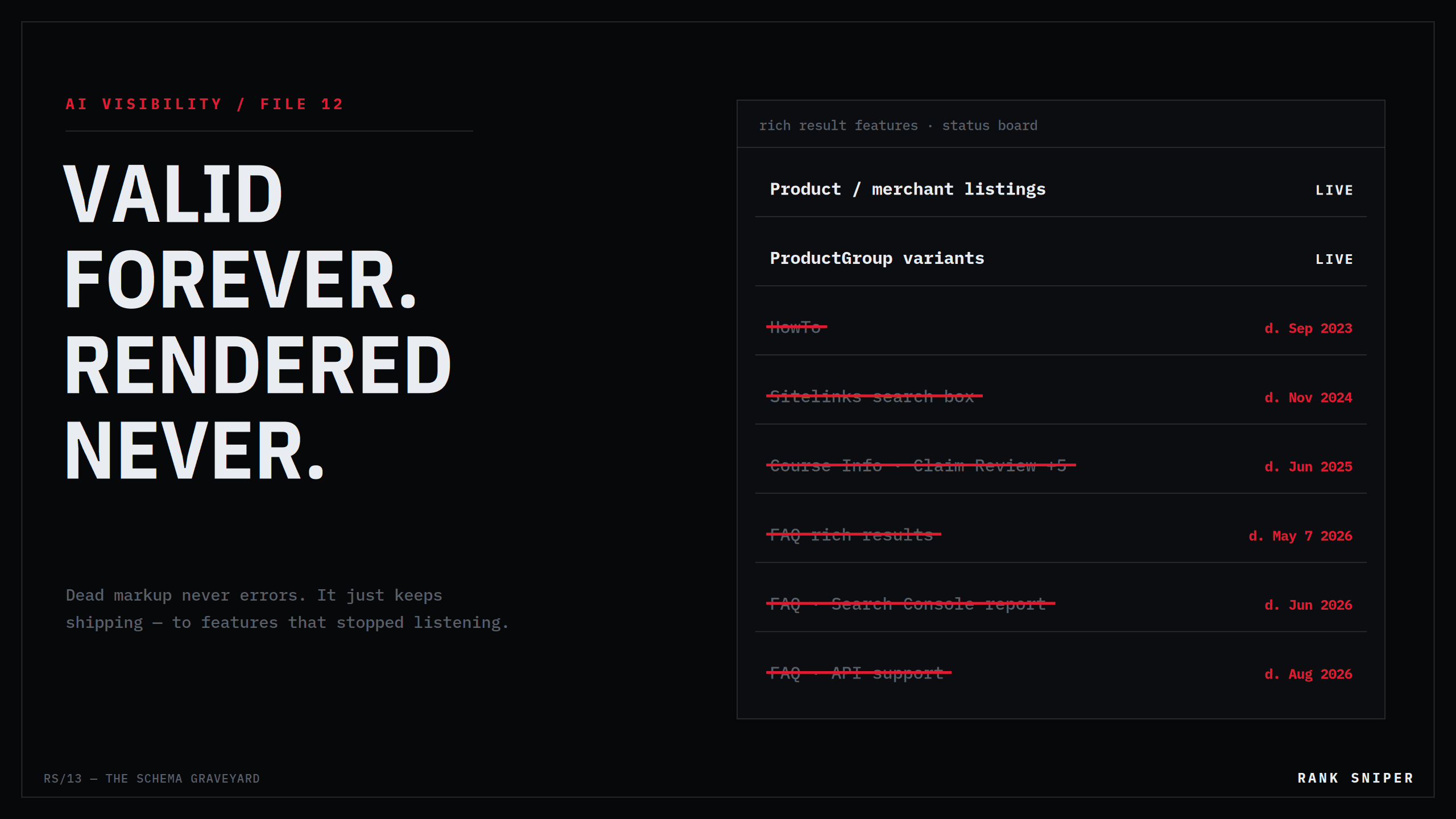
In July of this year, Ines — home goods, four hundred products, healthy skepticism — received an agency proposal. Professionally designed, confidently priced, and built around two deliverables: FAQ schema across her catalog "to win rich result dropdowns," and a HowTo content program "to capture step-by-step rich results."
The proposal was dated July 2026. FAQ rich results had been retired for every site on Earth since May 7, 2026. HowTo rich results had been dead since September 2023.
She was being sold real estate in a demolished building — by an agency that, in fairness, may not have known. Because here's the uncomfortable property of dead markup: it never errors. The schema validates. The JSON-LD parses. The plugin keeps emitting it, the theme keeps rendering it, the proposal template keeps selling it. Nothing anywhere says this feature no longer exists. Retirement announcements are quiet — the FAQ death was a banner quietly added to a developer doc, no blog post, no ceremony — and markup written for the deceased keeps shipping, valid forever, rendered never.
This file is the graveyard tour, with dates. The last one covered what current markup should say; this one covers what live markup is still saying to features that stopped listening.
The graveyard, in chronological order
HowTo — dead September 2023. The step-by-step rich result was removed from mobile in August 2023 and from desktop the following month. Fully retired, three years gone — and HowTo markup still ships on an enormous number of pages whose owners are waiting for stars that will never rise.
FAQ — restricted August 2023, dead May 7, 2026. The two-act pattern worth memorizing, because Google has now run it twice. Act one: the expandable Q&A dropdowns — once available broadly, then aggressively farmed by SEO tooling — were restricted in August 2023 to a small set of authoritative government and health sites. Act two: on May 7 of this year, a deprecation banner appeared on the FAQPage documentation stating the rich results no longer appear in Search at all — including for the government and health sites that had survived act one. The wind-down continues on a schedule: the Search Console FAQ report and Rich Results Test support were slated for removal in June, and Search Console API support ends this month, August 2026 — worth knowing if any reporting pipeline you rely on still queries it.
SearchAction / sitelinks search box — dead November 2024. The markup that powered the search box inside your sitelinks was retired in late 2024; the markup is simply ignored now. Themes generated it by default for years. Most still do.
The June 2025 batch — seven at once. Book Actions, Course Info, Claim Review, Estimated Salary, Learning Video, Special Announcement, and Vehicle Listing — retired together, with Google's stated reasoning that the features weren't widely used and no longer added significant value. Most don't touch a Shopify store; Vehicle Listing and Course Info touch some. The batch matters less for its contents than for what it confirmed: rich result features are a portfolio Google actively prunes, and the pruning has accelerated — 2023, 2024, seven in 2025, the biggest one in 2026.
Read the pattern once and you can't unsee it: restrict, then retire. A feature gets scaled hard by tooling, eligibility narrows, then the feature disappears — and the display real estate it occupied flows back to Google's own answer experiences. That's the direction of travel, and it's also why the four-pillar frame matters: the SERP-decoration era of structured data is ending on purpose, while the machine-legibility era — the one this series is about — is just starting.
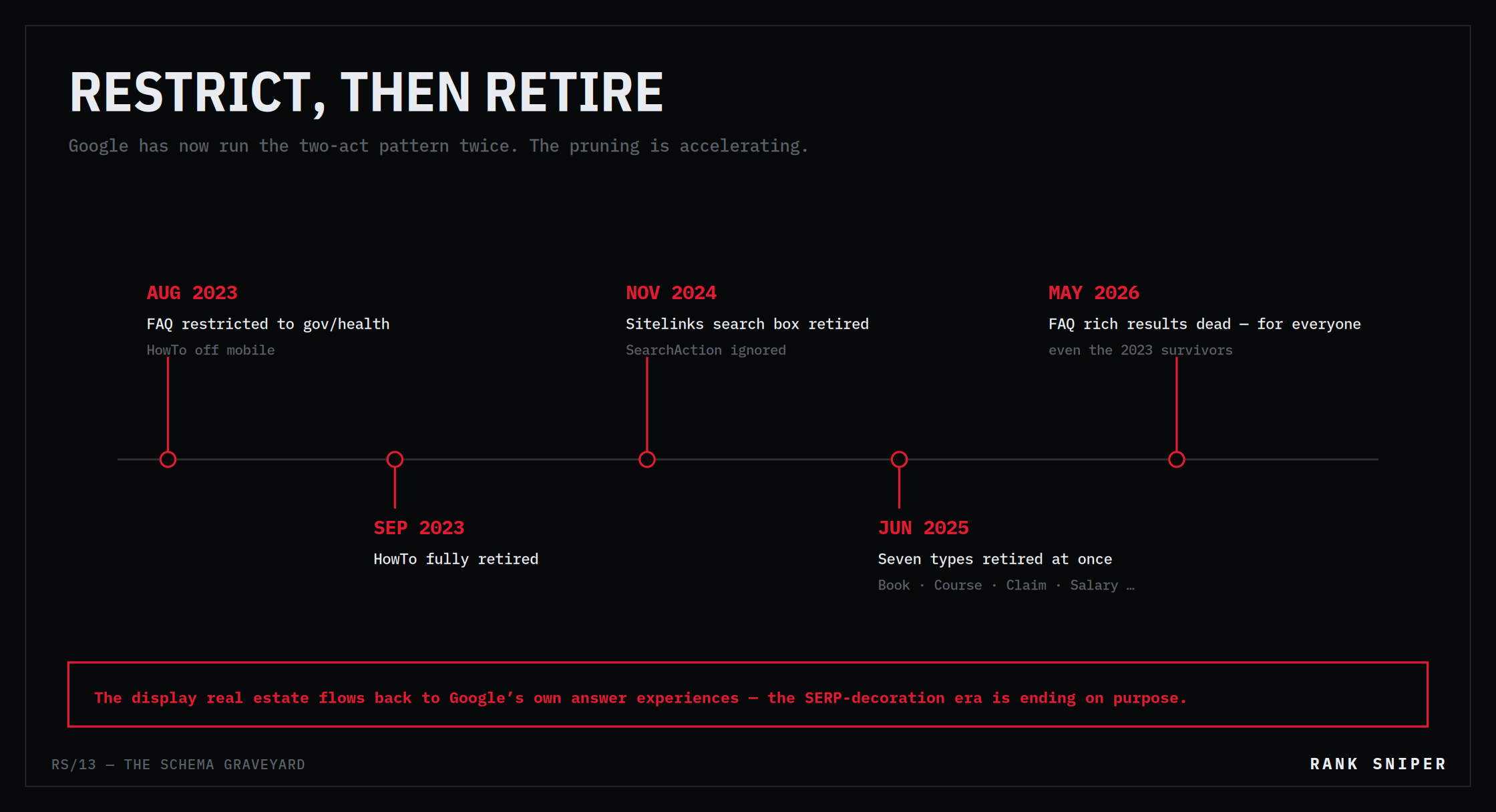 FIG.02 — Restrict, then retire. Google has now run the two-act pattern twice, and the display real estate flows back to its own answer experiences.
What "dead" means, precisely — and what it doesn't
Three different things get conflated in every hot take, and separating them is the entire practical value of this file:
The markup remains valid. FAQPage, HowTo, and the rest are still legitimate schema.org vocabulary; validators pass them without complaint — which is exactly why validators can't save you here. Google's own documented position is that unused structured data doesn't cause problems for Search; it just has no visible effect. Dead markup isn't a penalty. It's a monument.
The rich result is gone. The visible SERP feature — the dropdown, the steps, the search box — no longer renders, for anyone. Any deliverable, tool report, or agency line item promising these features is selling the past.
The content changes audience. This is the part both panic camps miss. Your FAQ content — real questions, clearly answered — didn't lose value in May. It changed jobs. Q&A content is precisely the shape that answer engines extract and cite: it's an AEO surface now, not a Google rich-result play. But hold that reclassification to this series' own evidentiary standard: Google's generative-AI guidance states plainly that no special markup is needed to appear in AI Overviews — so nobody gets to sell you "FAQ schema for AI citations" as the new dropdown. What earns extraction is the visible content discipline — a clear question, a clean answer, on the page. Keep the markup if it's there (it's harmless and machine-parseable); write the content for the answer engines; buy nothing that promises either one triggers a feature.
That's the honest reclassification: FAQ moved from SEO asset to AEO surface — same content, different audience, different (and humbler) promise.
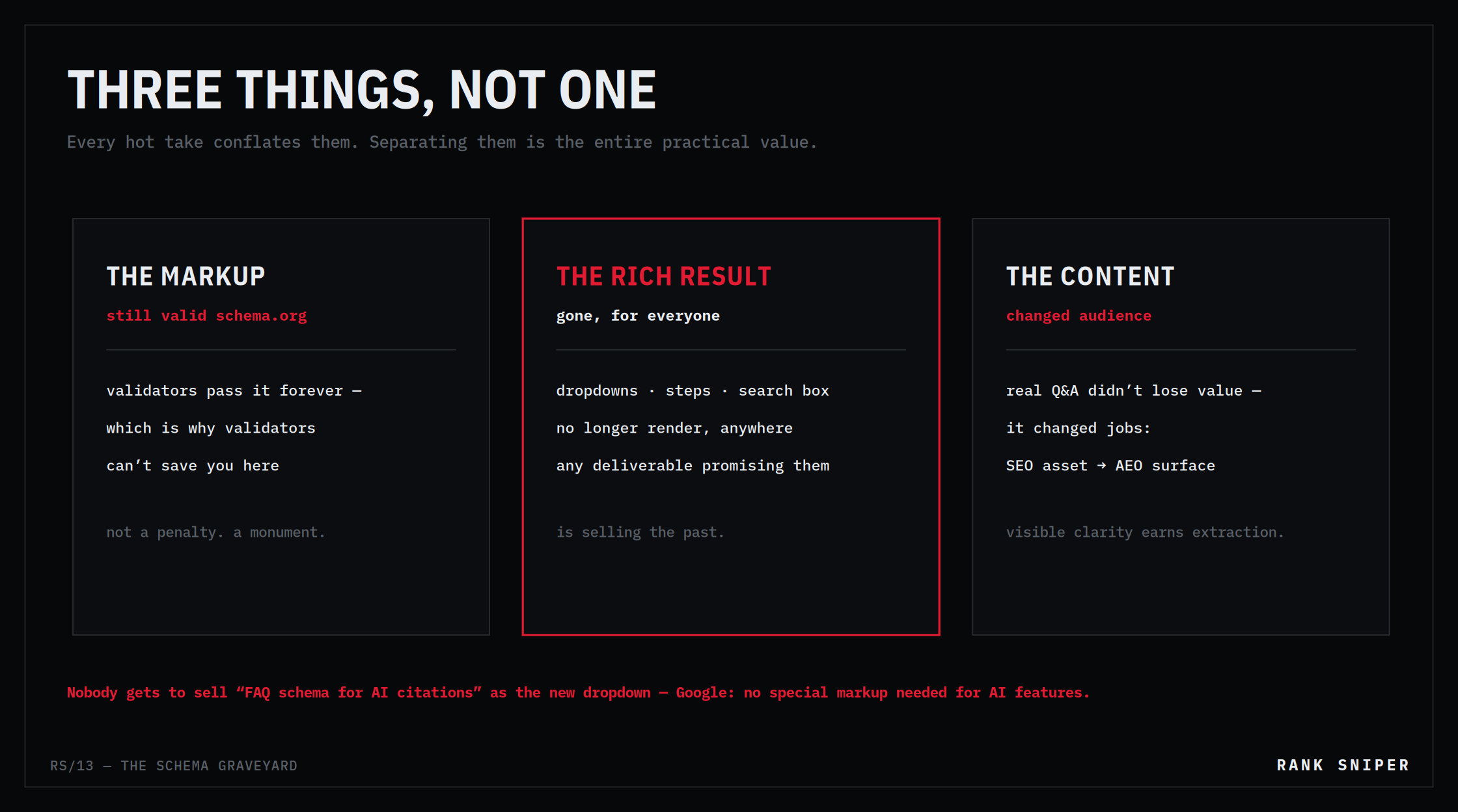 FIG.03 — Three things, not one. Every hot take conflates them; separating them is where the practical value lives.
The cost of building on graves
If dead markup is harmless, why does this file exist? Because the harm was never the markup — it's everything around it.
Misallocated effort. Every hour an agency bills against HowTo rich results is an hour not spent on ProductGroup, shipping data, and the markup that currently feeds live experiences. Dead-feature deliverables aren't neutral; they displace the live ones.
False confidence from green checkmarks. A validator pass on retired markup is the declared layer lying at a new altitude: syntactically perfect, operationally meaningless. "Valid" and "renders anything, anywhere" parted ways years ago.
Bloat where it hurts. JSON-LD blocks stuffed with dead types bury the Product markup that matters inside noise — for you, for your developers, and for every parser doing triage on your page.
The diagnostic it hands you. Here's the silver lining: dead markup in a 2026 proposal is the cheapest vendor-quality test you'll ever run. One question filters everything: "Which currently documented rich result does this markup target — link me the doc." A live feature has a Google documentation page without a deprecation banner. Anything that can't produce one is either dead or decorative, and a vendor who doesn't know which is telling you how they'll handle everything else.
The fifteen-minute exhumation
STEP 01 / GREP FOR GHOSTS. The wire, as always:
for t in FAQPage HowTo SearchAction potentialAction \
  SpecialAnnouncement ClaimReview EmployerAggregateRating; do
  printf "%-22s %s\n" "$t:" \
  "$(curl -s https://yourstore.com | grep -c "$t")"
done
Run it against your homepage and a product page. Nonzero counts on the retired types are your ghost inventory.
STEP 02 / SENTENCE EACH TYPE. Three verdicts, per type: Strip — SearchAction and HowTo scaffolding earn nothing and clutter much; removing them is hygiene. Keep as content, demote as promise — FAQPage where real Q&A renders on-page: the markup stays (harmless, parseable), the expectation changes to AEO surface, and it exits every traffic forecast. Redirect the effort — whatever budget or roadmap line was attached to dead features moves to the current-spec work: ProductGroup, shipping, returns, availability truth.
STEP 03 / DATE-CHECK EVERY FUTURE DELIVERABLE. The vendor question above, applied as standing policy: no markup work gets approved without a link to a live, banner-free Google documentation page for the feature it targets. Documentation link or it's dead.
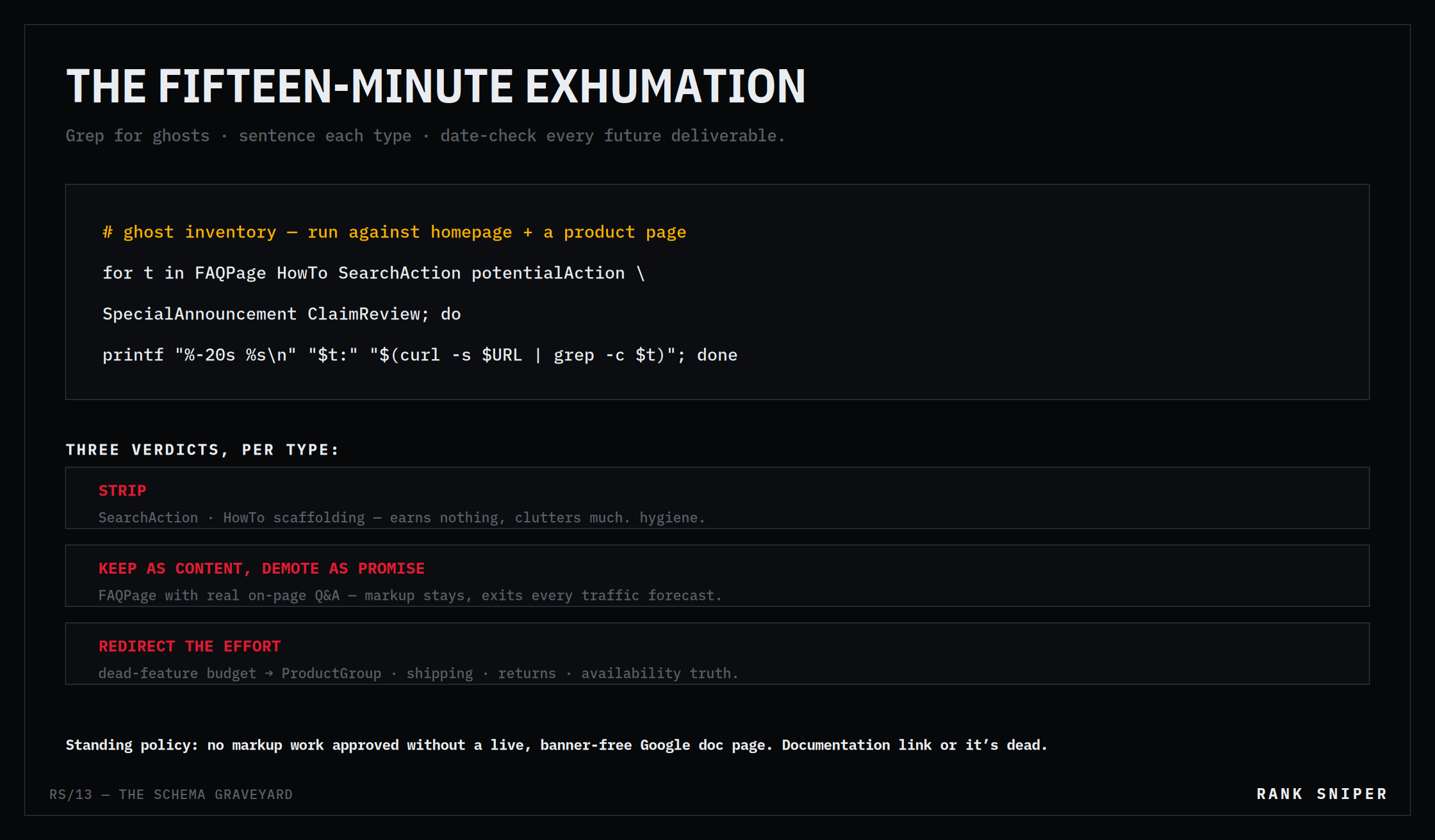 FIG.04 — The fifteen-minute exhumation. Grep for ghosts, sentence each type, and date-check every future deliverable.
The meta-lesson of the graveyard is the same one the vintage-theme file taught from the other direction: structured data isn't a thing you install, it's a claim you maintain against a spec that moves — sometimes by addition, sometimes by demolition, always quietly. The features died loudly only in hindsight. The stores still building on them never heard a thing.
One question survives the graveyard, and it's the interesting one: if rich-result decoration is dying, what actually earns machine trust now? The answer inverts twenty years of SEO instinct — and it's why a correctly typed weight field now does work that a backlink can't. Next file.
Sources & further reading
- Google — FAQPage structured data documentation (carrying the May 7, 2026 deprecation banner): https://developers.google.com/search/docs/appearance/structured-data/faqpage
- Google — Changes to HowTo and FAQ rich results (August 2023): https://developers.google.com/search/blog/2023/08/howto-faq-changes
- Google — Search Central Blog changelog (sitelinks search box retirement; June 2025 feature retirements): https://developers.google.com/search/blog
- Google — AI features and your website (no special markup required): https://developers.google.com/search/docs/appearance/ai-features
- Rank Sniper Field Notes — FILE 05: /blog/seo-aeo-geo-aio-four-pillars · FILE 10: /blog/verify-dont-generate-ai-product-content · FILE 11: /blog/product-json-ld-google-validates-vs-theme
Rank Sniper — Field Notes. Catalog legibility and AI-visibility verification for Shopify. We verify what AI agents actually receive from your store; we don't generate content and hope. Verifier, not generator.